The Two Americanisms
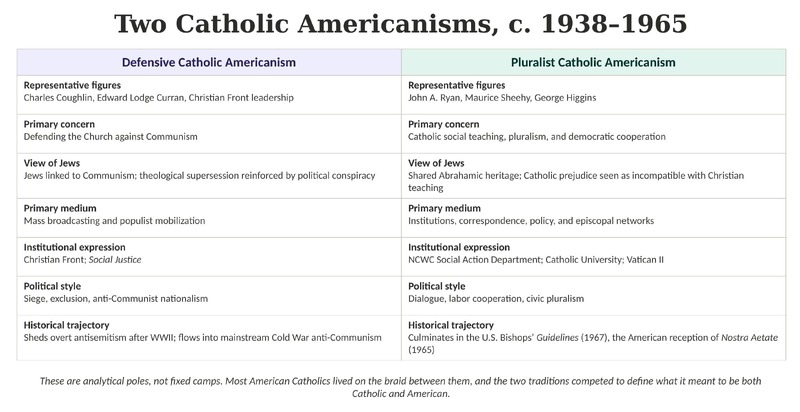
These were not just two groups of people with different tempers. They were two strains within the same church. In my chapter in Religious Responses to Kristallnacht, I call them two Catholic Americanisms — two ways of being Catholic and American at once, both fully in evidence by 1938.
The first was defensive, and its instinct was siege. It read the decade through the Spanish Civil War and the persecution of the church in revolutionary Mexico, and it concluded that the great enemy was communism and that Catholic survival required fighting it without qualification.
John McGreevy has shown how much of American Catholic politics in these years, including sympathy for the concordats Rome signed with Italy and Germany, grew from the conviction that Catholic religious liberty had to be protected first. Anticommunism became the mediator between being Catholic and being American.
For the vast majority of American Catholics in the 1930s, as I put it in the chapter, being Catholic meant being anticommunist in no uncertain terms, and the Vatican found this brand of American citizenship acceptable. Coughlin was the chief architect of this strain, and at its edges it shaded into sympathy for European fascism and into a frank antisemitism.
The second Americanism was pluralist. Its representative figures, John A. Ryan and Maurice Sheehy among them, were critical of Coughlin's radical anticommunism precisely because they saw it as constricting American individualism and political liberty. They looked for common ground between Judaism and Catholicism rather than for enemies, emphasizing Christ's own Jewishness and treating Catholic prejudice against Jews as a contradiction in terms.
Ryan came out of Minnesota's agrarian populism, a tradition that already carried its own suspicion of the Jew in figures like Ignatius Donnelly; he kept his own suspicion, however, aimed at concentrated wealth.
Coughlin, a Canadian immigrant, took up the same producerist language and made its antisemitism the center of it. That language found an audience Ryan never matched.
Michael Kazin's work on populism (The Populist Persuasion) helps explain why the first strain traveled so much faster on the air than the second. As Kazin describes it, populism is an oral, emotional idiom made for radio's intimacy, so Coughlin's strain broadcast far more readily than the pluralists' deliberative, institutional voice.
It helps to borrow David Gerber's distinction between ordinary and extraordinary antisemitism. American antisemitism was mostly ordinary — the antisemitism of the restricted hotel and the hidden quota, woven into daily life and rarely violent. What makes Coughlin worth starting with is that he was importing the extraordinary kind.
The pluralist strain could live alongside ordinary antisemitism. Coughlin was reaching for something else, and in November 1938 he reached for it on the radio.
References/Notes
1. On the two-strain thesis and the anticommunism-as-mediator argument: Maria Mazzenga, “Toward an American Catholic Response to the Holocaust,” in American Religious Responses to Kristallnacht (2009); John T. McGreevy, Catholicism and American Freedom (New York: W. W. Norton, 2003).
2. David A. Gerber, ed., Anti-Semitism in American History (Urbana: University of Illinois Press, 1986), 29–31.
3. Michael Kazin, The Populist Persuasion (Basic Books, 1995), 131.
4. Francis L. Broderick, Right Reverend New Dealer: John A. Ryan (New York: Macmillan, 1963).