From Declaration to Diocese
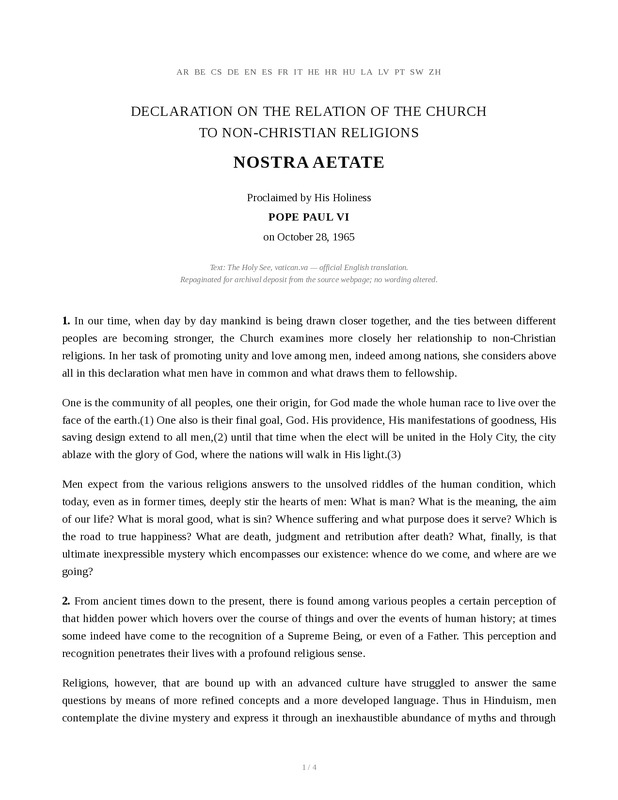
A declaration is not a program. When the Council promulgated Nostra Aetate in October 1965, it said, in the sentence that mattered most, that the Church “decries hatred, persecutions, displays of anti-Semitism directed against the Jews at any time and by anyone.” [1]
But a statement issued in Rome does not by itself change what is taught in a parish school in Cleveland or preached from a pulpit in Boston. Someone had to turn the declaration into instructions, and in the United States that work fell to a new unit of the bishops' conference, which moved quickly.
In the wake of the Council the American bishops created, within their Committee for Ecumenical and Interreligious Affairs, a Subcommittee for Catholic-Jewish Relations.
On March 1, 1967, barely sixteen months after the Council closed, the subcommittee issued its Guidelines for Catholic-Jewish Relations.
The language is plain about why it existed. “Responding to the urgency of the Conciliar Statement on the Jews,” the bishops wrote, they had established a body that would “devote itself exclusively to Catholic-Jewish affairs,” and the Guidelines that followed were “designed to encourage and assist the various dioceses” in putting the Council's directives into action at every level of the church. [2]
Read the directives and you can see whose program this was. Every diocese where Jews and Catholics lived was to assign someone to Catholic-Jewish affairs. School texts, prayerbooks, and preaching were to be examined and cleared of anything that did not accord with the Statement.
Catholic teaching was to present the Crucifixion without collective guilt, to give “a frank and honest treatment of the history of Christian anti-Semitism,” and to fund serious scholarship by Catholic and Jewish scholars together.
This is the textbook and liturgy review that Marc Tanenbaum and the American Jewish Committee had pressed on Cardinal Bea during the Council, now written into American diocesan policy. The memoranda the AJC had submitted in Rome came home as instructions to pastors.
This is the setting in which Higgins did his work, and it is the payoff of the inclusive Americanism traced across this collection.
The pluralist strain never had Coughlin's audience, but in the end it had something better. It had the institution.
The same American church that in 1939 let Coughlin run the Communist Baby in Social Justice was, by 1967, instructing its dioceses to teach the history of Christian antisemitism honestly and to sit down with the local rabbi.
Higgins is a human link across those thirty years, the labor priest turned council broker turned architect of implementation, and the 1967 Guidelines are what his Americanism looks like once it stops being a disposition and becomes a policy. It took the church until 1965 to answer Coughlin. It took until 1967 to tell the parishes how.
References/notes
1. Second Vatican Council, Nostra Aetate, no. 4 (October 28, 1965).
2. “Guidelines for Catholic-Jewish Relations,” Bishops' Committee for Ecumenical and Interreligious Affairs, March 1, 1967.