Nostra aetate: The Correspondence
Higgins's most important work on Catholic-Jewish relations is the part almost no one saw. He never sat on the drafting commission and never wrote a line of the Declaration. He worked the seams. Early in the Council an emissary of Cardinal Bea asked him which American bishops would back a statement on the Jews, and before long Higgins was meeting Bea himself.
Higgins biographer Gerald Costello calls him “an intimate participant” in the Declaration, “never as an actual member of the commission or a drafter of the document, but as a liaison between Jewish observers at the Council and the bishops, and as a writer of speeches for several American bishops who supported it on the Council floor.” The Jewish observers he worked with were two men who became close friends.
Marc Tanenbaum knew from the inside the thing the Declaration was against. Baltimore-born, he was turned away from Johns Hopkins as a young man because the university had filled its quota for Jews, and he went instead to the Jewish Theological Seminary of America. Ordained in 1950, he ran the Synagogue Council of America and then, from 1961, directed interreligious affairs at the American Jewish Committee, where he spent nearly thirty years and became the best-known Jewish advocate in America for open dialogue with Christians.
Zachariah Shuster was the committee's man in Europe. A Pole who came to the United States in 1927, he served on the American delegation to the United Nations in 1945 and from 1948 ran the AJC's Paris office, rebuilding and securing Jewish communities across a continent that had just tried to erase them. When the Council opened, he was the natural person to work Rome.
The American Jewish Committee did not come empty-handed. It was invited to submit memoranda to Bea's Secretariat on how Jews were portrayed in Catholic schoolbooks and in the liturgy, and in 1963 it arranged a meeting between American rabbis and Cardinal Bea that ended with Bea affirming the need for “interreligious communication and cooperation.” That is the quiet machinery. The letters show it running.
What the series of letters between Higgins, Tanenbaum, and Shuster add is the sight of the American pluralist strain actually working, in real time and behind the scenes of the Council.
The channel opens in October 1962, in the first days of the Council.
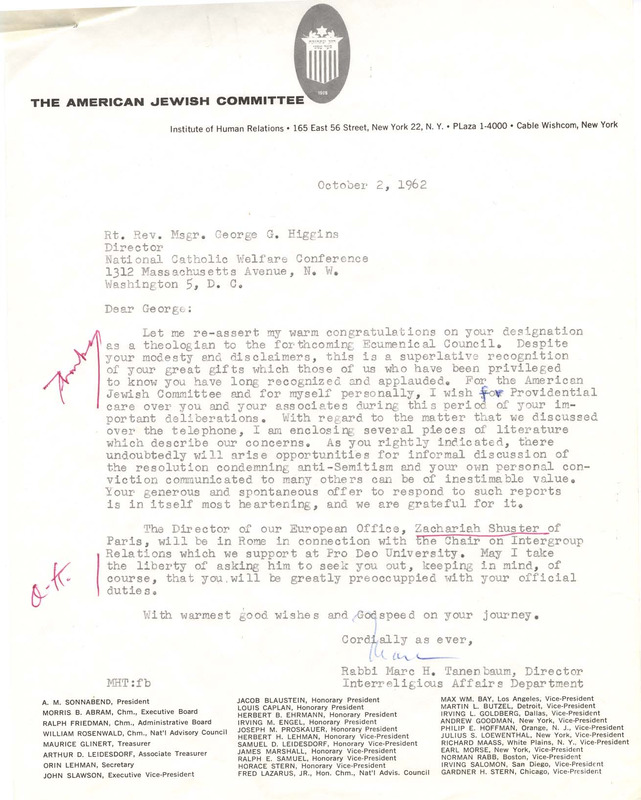
Tanenbaum writes to congratulate Higgins on his appointment as a peritus and to name the job he hopes Higgins will do. Opportunities will arise, he writes, for “informal discussion of the resolution condemning anti-Semitism,” and Higgins's “own personal conviction communicated to many others can be of inestimable value.” In the same letter he introduces Zachariah Shuster, the AJC's man in Europe, and asks permission to have him “seek you out” in Rome.
Two days later Higgins accepts without hesitation. He will take the AJC's material to Rome, he writes, and “be on the lookout for opportunities to put it to the best possible use.” [1] The channel is open, and it is an American one: a New York rabbi, a Paris-based AJC director, and the Washington priest who knew the bishops.
Through 1963 the letters are mostly Shuster writing from Rome, cultivating the man who mattered most to the drafting, Cardinal Bea. After an American Jewish Committee audience with him, Shuster reports that everyone was “deeply impressed by the clarity of vision, the wisdom and the precision of thought of this great statesman of the Church.” [2] The tone is warm and gossipy, full of shared jokes about curial politics.
By 1964 the work turns serious. In May, Higgins writes Tanenbaum with a blunt request. Send me “reliable statistical information about the extent of the Nazi persecution and massacre of the Jews of Europe,” he asks, and “if possible… from non-Jewish sources.”
He explains why. He needs it “as ammunition in a private little war I am carrying on with a friend of mine who, even at this late date, continues to argue, against all of the evidence, that the extent of the persecution of the Jews by the Nazis has been greatly exaggerated.” [3]
Twenty years after the camps, a man in Higgins's own circle is minimizing the Holocaust, and Higgins is quietly assembling the evidence to shut him down. He wants it from non-Jewish sources precisely so it cannot be waved away.
Then the crisis. In June 1964 Shuster writes from Rome that the mood is “somber.” The reports on Chapter IV, the passage on the Jews, are “disquieting.” The plan, he warns, is to cut “what is considered by many, including myself, the heart of the matter, namely, the passage on the responsibility for the crucifixion.”
Higgins's reply is this: “Please be assured,” he writes, “that I am working very hard behind the scenes to prevent any watering down of Chapter IV. To my personal knowledge, a number of influential American bishops have already written to Rome about this matter, and I feel reasonably certain that they will be prepared to take the matter to the floor of the Council in September if this proves to be necessary.”
A few months later he is plainer still. He will “do everything I possibly can in Rome to persuade some of the key members of the American hierarchy to take the leadership in carrying on this fight to a successful conclusion.” [4]
The passage on the Jews was being watered down at its center, and the American bishops, whom Higgins was working to line up, were among its most determined defenders.
The last letters, from December 1965, are written after the vote. The Declaration has passed. Higgins thanks Tanenbaum for “the constructive tone of your recent statements” and looks ahead to “the work of our newly established Commission on Catholic-Jewish Relations,” the body that would issue the 1967 Guidelines. The final exchange is domestic and warm: a missed television appearance, a scheduling conflict because Higgins's colleague John Cronin is in New Orleans for the consecration of the first African American bishop. [5]
The interfaith work, the racial-justice work, and the labor work all belong to the same men and the same strain.
Higgins never drafted a line of Nostra Aetate. What the correspondence shows is the thing the civic-pluralist strain was built to do and Coughlin's never could: keep a channel open between the two communities, press the case behind the scenes, and help rally the American bishops when the hardest passage was under threat.
References/notes
The biographical paragraphs above (Higgins's hidden role, the Costello quote, the Tanenbaum and Shuster biographies, the AJC memoranda) all draw on: Maria Mazzenga, “Monsignor George Higgins, Rabbi Marc Tanenbaum, Zachariah Shuster, and the Declaration on the Relation between the Church and Non-Christian Religions,” Jewish/non-Jewish Relations (JNJR). The Costello quotation specifically: Gerald M. Costello, Without Fear or Favor: George Higgins on the Record (Twenty-Third Publications, 1984), via the JNJR essay.
1. Marc H. Tanenbaum to George G. Higgins, October 2, 1962, and Higgins to Tanenbaum, October 4, 1962, George G. Higgins Papers, ACUA, Catholic University of America; correspondence reproduced in Maria Mazzenga, “Monsignor George Higgins, Rabbi Marc Tanenbaum, Zachariah Shuster, and the Declaration on the Relation between the Church and Non-Christian Religions,” Jewish/non-Jewish Relations, https://jnjr.div.ed.ac.uk/primary-sources/contemporary/monsignor-george-higgins-rabbi-marc-tanenbaum-zachariah-shuster-and-the-declaration-on-the-relation-between-the-church-and-non-christian-religions/.
2. Zachariah Shuster to Higgins, December 29, 1962, Higgins Papers, ACUA, Catholic University of America.
3. Higgins to Tanenbaum, May 15, 1964, and Tanenbaum to Higgins, May 20, 1964, Higgins Papers, ACUA, Catholic University of America.
4. Shuster to Higgins, June 11, 1964; Higgins to Shuster, June 19, 1964; and Higgins to Tanenbaum, September 3, 1964, Higgins Papers, ACUA, Catholic University of America.
5. Higgins to Tanenbaum, December 14 and December 30, 1965, Higgins Papers, ACUA, Catholic University of America.